Bass Guitar Buyer's Guide
It takes top-shelf gear to bring that low end and a bass player's one-stop shopping destination is AMS. If you've never purchased a bass before we will help you find your first. If you've been slugging it out in clubs or on the road we've got the gear you need for that huge live sound. 4 string basses? 5 string basses? 4x10 cabs? 8x10 cabs? Effects pedals? The AMS Buyer's Guide for Electric Bass is the only resource you'll need.
Advice for First Time Buyers
Before you start searching for your first bass guitar consider the following:
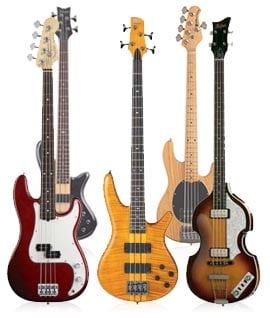 Check out the complete listing of Bass Guitar Packages
1. Price range
Check out the complete listing of Bass Guitar Packages
1. Price range
Set an appropriate price range. You can easily filter your search results on AMS using the price range selection filters on the left side of the page or sort by 'Low to High' or 'High to Low' to see all products in order of price.
2. Size/age of the player
Bass guitars are available in a variety of shapes, sizes and weights so it's important to find one that will be the best physical fit for the player. Consider the player's age, height and the size of their hands. Bass players who are younger or smaller in size will do best with basses that have thin necks, short scales and are light weight. Bass players who are tall or have large hands will probably be more comfortable with heavier basses with wider necks and longer scales. In order to properly play your instrument you have to be able to handle it comfortably.
3. Style of music you want to play
Rock, Metal, Punk or Jazz the style of music you play requires the right tool for the job. There are a wide range of instruments to choose from: some basses are known for their versatility and are used across several genres of music and some basses have a reputation for being genre-specific. Identify your favorite bands and bass players and research the gear they use: the guy in the jazz trio most likely isn't using the same gear as the guy in the metal band.
4. Electric Bass Guitar Package - Safe bet for the beginner
If you're new to playing bass or just need a quality instrument with all the accessories, an Electric Bass Guitar Package may just be the ticket. Available in a variety of styles, these packages feature everything you need to start jamming including an amp, instrument cable, strap, gig bag and more.
Scale Length & Neck Setting
Scale Length
Scale length refers to the distance between the nut at the guitar's headstock and the bridge at the base of the guitar. This area is where the strings vibrate when strummed. Different scales will create different levels of tension on the strings and effects tone and playability.
Long/Standard Scale
34"
Higher tension
Sharp sound
The low B string on 5-string basses has more punch on a long scale neck.
Short-Scale
30"
Lower tension
Round sound
Neck Settings
Bolt-On Neck
The neck and body are separate pieces with the neck bolted to the body.
Easy to adjust.
Set Neck
The neck and body are separate pieces with the neck attached permanently to the body.
Great sustain and resonance.
Neck-Through-Body
The neck extends thru the length of the guitar with the body attached to the sides of the neck.
Thru neck construction offers unmatched sustain.
Body Wood
A major part of a guitar's tone is shaped by the wood used to create the body, neck and fingerboard. The most commonly used woods include Alder, Ash, Mahogany, Maple and Rosewood. Each type of wood has its own color, grain and density and creates its own unique tone.
Alder
Look: Light blonde
Feel: Light
Sound: Alder creates a full sound with a balanced mix of high, middle and low frequencies
Ash
Look: Light blonde
Feel: Ranges from light to heavy depending on the type of Ash
Sound: Ash creates a bright sound with good sustain
Mahogany
Look: Light to dark brown
Feel: Medium to heavy
Sound: Mahogany creates a warm sounding tone with good sustain
Maple
Look: Blonde
Feel: Heavy
Sound: Maple creates a bright, sharp tone with plenty of sustain