
Related 12 String Acoustic Guitar Content

Beginner Acoustic Guitar Buyer's Guide

Acoustic vs. Electric Guitars

Guitar String Buyer's Guide
Featured Brands


Get FREE shipping on all orders!
Fast FREE shipping on all orders!


6 Payments of $33.33
A 12-string acoustic guitar has twice as many strings as a six string. Duh, right? But it’s not like you need to sprout extra fingers or learn new chord positions to play one. Rather than having six individual strings like a regular acoustic, 12-strings have six pairs of strings. You play it exactly the same way except you push two strings down at a time when you fret.
The pairs of strings are tuned to the same note. The lower four pairs of strings (E, A, D, and G) are tuned to octaves, so one string plays the regular note you’d expect from a six-string acoustic, but the second string is tuned to an octave up. The top two pairs of strings (B and E) are tuned in unison. This gives you a much broader, chorus sound compared to a regular six-string acoustic.
The tradeoff is higher string tension and a slightly wider neck, but they’re both easy to manage once you know what you’re getting into. It’s just like playing a regular six string but you have to press a little harder. That’s all!
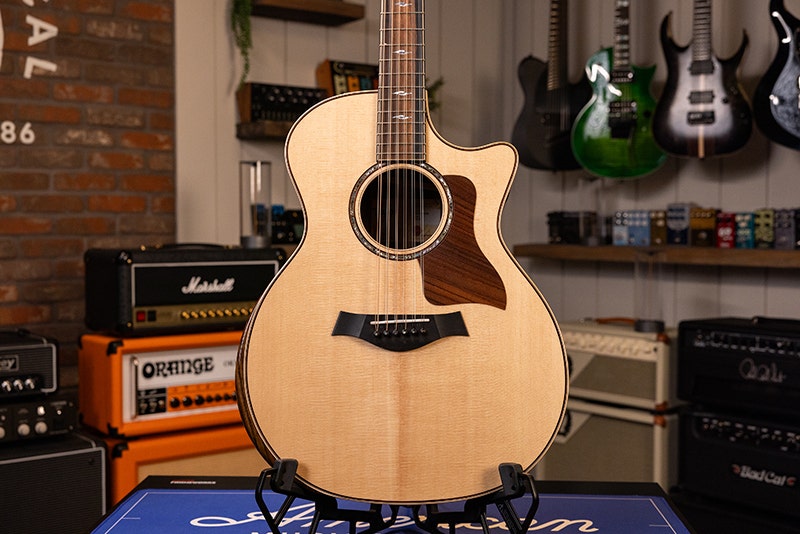
Each of the six string positions is doubled into pairs. On the lower four pairs, E, A, D, and G, the added string is tuned an octave higher than the main string. On the top two pairs, B and E, the added string is tuned in unison at the same pitch.
Strumming both strings in each course at once produces the natural chorus effect that defines a twelve-string acoustic guitar, a fuller, more layered tone than a single string can produce alone.
It’s harder to play than a six-string, but it’s not “hard” to play. A 12-string acoustic guitar takes more finger strength than a six-string because of the extra strings add tension across the neck. Fretting clean chords and barre chords take a little more effort, and the neck is slightly wider to fit the paired strings. Most players adjust within a few weeks of regular practice.
A 12-string guitar for beginners is rarely the right first choice. It is a great pick once you already have solid fretting-hand strength on a six-string — but not before. If you’re already pretty confident with a six-string, then a 12-string acoustic might be a fun musical adventure.
Buying a 12-string acoustic is similar to buying a 6-string. You want to look at four main considerations to find the right choice for your style and abilities.
A larger body makes the chorus effect fuller and more resonant, which is why dreadnought and jumbo are the most common body styles for a 12-string. Concert or parlor 12-strings exists, but the smaller body has less room for the extra string tension to bloom into a full chorus. Shop Dreadnought Acoustic Guitars.
Guild has built the widest 12-string lineup at AMS, with a dreadnought around $900 to jumbo models near $4,400. And the brand's F-Series is close to an industry standard 12-string as you can get. Yamaha offers a dependable dreadnought 12-string near $480 for players who want a first 12-string without a large investment. Above $1,000, boutique options expand the field for players who want a specific, sometimes high-tuned instrument.
A 12-string neck runs wider than a standard 6-string neck to leave room for six paired courses. Be sure to check the nut width before buying to make sure it’s a good fit for your preferences — especially players with smaller hands. The neck width and string tension (how hard it is to press down) are the two most common frustrations for new 12-string players.
12-string guitar tension is higher than on a 6-string, so a proper truss rod adjustment matters more here than there. If a 12-string buzzes or the action feels high, have a tech check the truss rod and neck relief rather than assuming the guitar is defective. A common 12-string guitar tuning trick is dropping a half step to Eb or a full step to D, which reduces string tension and makes fretting noticeably easier without a real loss of tone.
Still weighing a 12-string vs. 6-string guitar decision? Start with how much the fuller, chorused tone matters to you versus how much easier a 6-string is to fret. A 6-String Acoustic Guitar gives you the same body styles without the added string count or the extra tension. Players who want the 12-string sound with an amp in the mix should look at 12-String Electric Guitars instead. 12-string electrics are also a bit easier to fret because they have lighter gauge strings.
Browse our full acoustic guitars collection to compare every body style side by side.
A 12-string needs a dedicated set of strings built for the extra tension, plus a case that protects the larger headstock. Shop 12-string acoustic guitar strings and acoustic guitar cases to round out your setup.
The extra six strings create a natural chorus effect that a 6-string can’t produce, giving a single guitar a fuller, more layered sound. Players use this to make a solo performance sound bigger or to add texture in a full band mix without adding another instrument.
It can be. It takes more finger strength than a 6-string because of the added string tension and slightly wider neck. Most players adjust within a few weeks, and tuning down a half step or full step makes the adjustment period easier.
A dependable 12-string starts around $200 to $500 for a beginner or backup instrument, and $900 to $1,500 covers most players who want a long-term guitar. Premium and USA-made models run from $2,500 up to $4,500 or more.
Not better, just different. A 12-string produces a fuller, chorused tone suited to strumming and layered arrangements, while a 6-string gives more precise note separation for lead lines and fingerstyle detail. The right choice depends on the sound you want, not which one wins on paper.
It’s called a 12-string guitar or a 12-string acoustic, and each of its six string positions is called a course. There’s no separate name for the instrument beyond describing the string count.
Many players tune a 12-string down a half step to Eb or a full step to D to reduce string tension. This makes fretting and bending noticeably easier and causes only a small, usually unnoticed change in tone. A capo on the first or second fret brings the guitar back to standard pitch if needed.
American Musical Supply carries 12-string acoustic guitars from Guild, Yamaha, and more, from first upgrade to USA-made jumbo. Free shipping. Easy returns. 0% interest payment plans available.