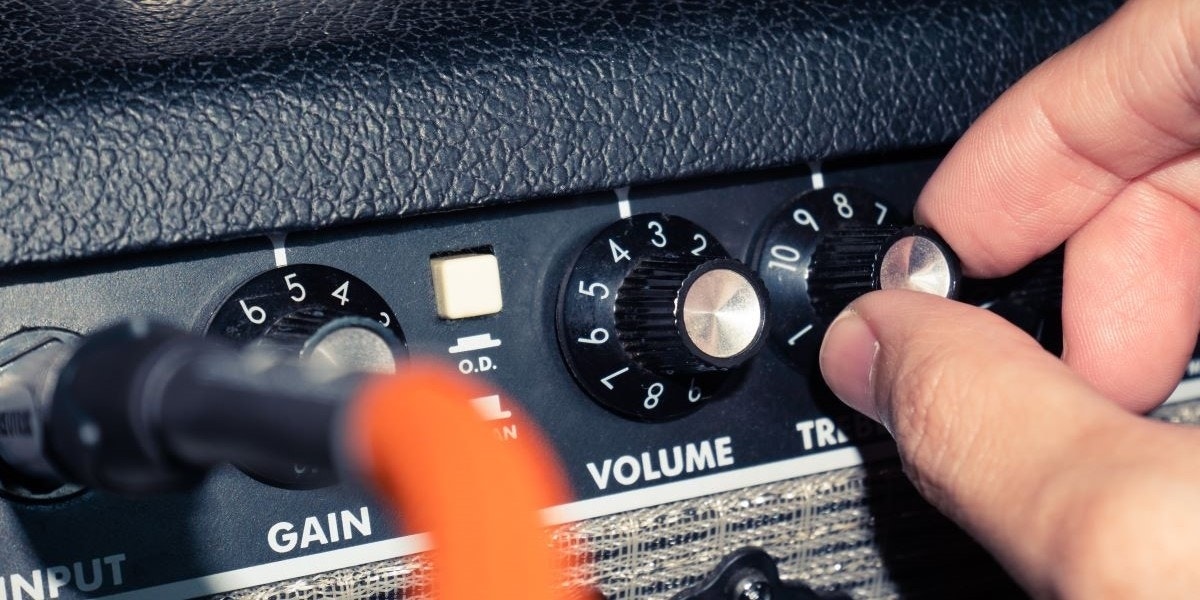
Dialing in your amp to capture a great sound is both an art and a repeatable process. The greats have all learned how to get their amp and tone to sound like them, giving it a character-like quality. You’ll come to learn that much of the mystique lies in small movements or tweaks to the EQ section of your amps and pedals.
Dialing an amp isn’t just twisting knobs; it’s about understanding several interconnected elements including your source (guitar, pickups, playing dynamics), amp type, EQ, and gain staging. We’ll also take a look at how volume, headroom, and even the room you’re playing in affect your tone, and how pedals can enhance what your amp is already doing. Don’t worry though, we’ll run through some troubleshooting fixes so you can confidently dial in any amp, anywhere.
Starting With The Source: Your Guitar
When dialing in your amp, many forget that the first source is your guitar. It’s important to understand what tonal characteristics your source has. Some guitars have bright single-coils which push more on the high end, while humbuckers tend to provide that warm emphasis on the mids and lows. With this being known, your pickup selection has a big say in what sound is going to come out of your amp, since you can use either or combine your bridge and neck pickup tone controls.
If your guitar sounds overly bright, the amp can’t really fix it — but it CAN exaggerate it. And it’s the same with picking dynamics. The lighter the touch, the rounder and clearer your sound will be. The heavier the attack, the more bite and compression your amp will produce. That’s why it’s important to understand the foundation before we hop on over to the amp settings.
Understanding Your Amp Type
Now let’s get into amps. Getting to know the amp you’re playing through makes it all that much easier when it comes to dialing in your tone.
Each amp type has a distinct personality:
- Tube = warm, dynamic, expressive
- Solid‑state = reliable, clean, consistent
- Modeling = versatile, feature‑rich, budget‑friendly
- Hybrid = a blend of tube feel and solid‑state practicality
Tube amps tend to be louder than solid state amps, and the louder you turn up, the more natural bite and overdrive comes out. Just think of the drive sound that came from players like Jimmy Page and Pete Townshend. Solid-state amps tend to be more sterile sounding and don’t always sound great when being pushed too hard, so keep that in mind when plugging in. These different types of amps respond differently based on their unique EQ emphasis which is usually inherent to the build.
You’ll hear names like British-voiced or American-voiced as a category that specific amps belong to. Amps that are British-voiced include Marshall, Vox, Orange, and Blackstar. These tend to have an emphasis on the upper-mid section, producing what’s described as crunchy, throaty or even cutting tone. Any of those tube amps are using EL34s or EL84 tubes, which are common in those types of circuits and make a big contribution to that sound characteristic.
On the other hand, any American-voiced amps will usually be Fender, MESA Boogie, EVH, and Peavey. These amps are great at giving you bright and high crisp tones, which make a solid choice for those that want a clean headroom at higher volumes. You get emphasis on those treble and bass EQ profile which allow for a smooth and warm breakup when pushed.
Set a Neutral Baseline
When dialing in your amp and to make this a repeatable process for anywhere you go, the trick is in giving yourself a predictable starting point. Make sure your gain is turned down and that your volume is at a comfortable level, that way we don’t harm anyone’s ears in the process. Most amps are designed so that 12 o’clock is the “flat” or neutral position. So, you can set your Bass, Mids, Treble, and Presence all to the noon position (which is usually 5, if the knobs have numbers). This now gives you a balanced frequency as your starting point.
Another thing to note, if you’re using any pedals or a pedalboard floorboard unit, make sure none are on or actively coloring your sound. No boosts, no drives, and no reverbs or delays.
Now, with your axe’s volume and tone controls turned all the way up, start playing and listen to the voice coming out of the amp. Is it dark or muddy? Does it need to be brighter or have more presence? Does it have the fullness in its foundation coming from the low-end of the EQ spectrum?
Here's a breakdown of each control:
- Bass — Low-end control, weight, thump
- Mids — Body, character, thickness
- Treble — Brightness, clarity, bite
- Presence — High-end air, openness, liveliness
If my sound is a bit dark or muddy, I’ll aim to lower the mids down to 3.5 or 4 and maybe have the bass sitting around 5 or 5.5. Depending on what guitar I have, if I’m working with a Strat or Tele (something with single-coils) and I’m getting those icepick highs, I’ll lower the treble down to 4 or so and maybe turn up the bass and mids as needed. This is where your ears will learn the most.
Here are three common EQ baselines (adjust to taste):
- Clean tone — Bass 6 • Mid 5 • Treble 6 • Presence 4
- Rock crunch — Bass 5 • Mid 6 • Treble 5 • Presence 5
- High‑gain metal — Bass 4 • Mid 3–4 • Treble 6 • Presence 6
If you feel like you’re getting lost in the mix, turn up the presence on your amp to help give you that needed clarity without sounding like you’re scratching a chalkboard. As you turn each of the knobs, you’ll get a feel for what’s desirable and when you need to focus on some more shaping.
Dial in Gain Properly
When you focus on getting your gain to the proper setting, it’s always important to prioritize clarity first, then saturation. When you have your amp’s gain activated, start low and begin picking with the same intensity that you use when you normally play. Each amp varies when it comes to the breakup point. Raise the gain level and adjust your volume accordingly.
As the gain increases, notice how your amp responds to your touch. Perhaps it might be more sensitive and notes can blend together much easier. I think here would be important to notice that your preamp gain comes from your drive knob and the master volume will produce saturation coming from the tubes of your power amp. There you can get warm, blooming, even-order harmonics.
From there, you can go one of two ways to establish your EQ settings. You can start by turning all knobs back to 12 o’clock and adjust your curve from there, or you can adjust your EQ from the same settings you had your clean stage on and adjust from there. I’d recommend the latter because often times while playing, you’re not going to have the chance to break and set everything up from scratch. Often times you won’t need to move your setting around much when differentiating between your clean and overdrive channels.
Finding Your Sound
Dialing in an amp is really about shaping a tone that reacts to your touch, cuts through a mix, and stays musical at any volume. Your EQ controls define the character of that response: how tight the lows feel, how forward the mids sit, and whether the highs cut through or glide. They determine whether your tone sits forward, sits back, or gets lost entirely.
Great tone ultimately comes from balancing saturation with shaping. Gain gives your sound its drive and intensity, while EQ gives it its voice. Once you understand how those elements interact, your amp stops feeling like a collection of knobs and starts becoming a tool for expressing exactly who you are as a player.
Fuchs ODH Hybrid Guitar Amplifier Head 300 Watts
Special Price $1,349.99