
When you see the term “effects pedals,” it’s usually accompanied by the word “guitar.” It’s fair that the two have often been linked together. Historically, the guitar is what effects were originally designed for. But things now aren’t so limiting, as many people over the years have incorporated them alongside bass guitars, keyboards, band and orchestra instruments, and vocals.
So, if you’ve been thinking of putting actual vocal screams through an Ibanez Tube Screamer, you’re in luck. That sort of thing is exactly what I’ll be talking about in this piece — and it’s a lot of fun!
Getting Started with Effects Pedals
First thing is first, you should know that guitar pedals are designed to work with instrument-level signal.
A standard guitar effects setup is pretty straightforward. You plug one end of your 1/4” TS instrument cable into your guitar and the other end into the input of the first effects pedal in your chain. Then, using 1/4” TS patch cables, you go from the output of that first pedal to the input of the next pedal. You repeat that process for each pedal on your board until you reach your last one. Then, you’ll run a final 1/4” TS instrument cable from the output of your last pedal into the input of your guitar amp.
Using Pedals with Microphones
But what about when you use a vocal or instrument microphone with guitar effects? Here’s where you need to make some adjustments and incorporate some gear to get the proper signal strength for all of your non-guitar-based sound alternatives.
So, it’s just as easy as using a female XLR-to-1/4” cable to plug your microphone into the beginning of the effect chain on one side and then a male XLR-to-1/4” cable from the end of the effect chain to the mixing console on the other side… right?
Well… not so much. Even with the adapters, you’ll still be transmitting instrumental-level signal to the mixing console. In order to get full signal with all of the detail and more accurate headroom in the audio mix, you’ll need to boost things up!

Radial Engineering Voco-loco MK2 Vocal Microphone Effects Switcher
Special Price $399.99
That’s where an external preamp device like the Radial Voco-Loco comes into play.
This handy gear piece boosts the signal from guitar effects up to line-level. It has a mic input and an effects loop that goes: 1/4” TS instrument cable out of the Voco-Loco to the start of your pedal chain, then from the end of the pedal chain back into the Voco-Loco, and finally a line-level XLR output that runs to the mixing console or interface. Now you have stronger, more robust, most consistent signal that will sound better and be easier for the engineer to mix.
Multi-Effects, Multiple Possibilities
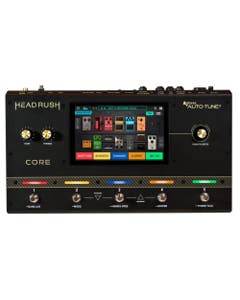
With its entire enclosed ecosystem of effects, full menu for programming signal chains, and plenty of connectivity options including USB to your computer, many people are choosing the all-in-one multi-effects box for all of their sound sculpting needs. These work with standard guitar amps but can also can go amp-less with direct outputs that can go right into a mixer, interface, or personal monitor.
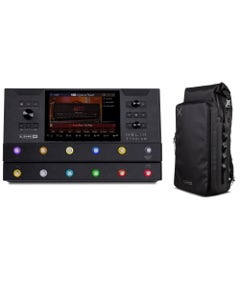
Most modern multi-effects units (such as the Line 6 Helix) also have several inputs for guitar, microphone, and auxiliary sources. That means you’ll have the right types of signal strength available for a wide variety of applications. Be sure to consult the manual to know exactly what levels those inputs are intended for and how best to use them.
If you’re not necessarily looking to take the journey and build a custom pedalboard with individual pedals, multi-effects from Line 6, Headrush, Neural DSP, and other production brands can serve as your go-to right out of the box.

Instrumentalists: Don’t Think Like a Guitarist; Think Like a Chef
Here is my rule-of-thumb for starting out using effects on non-guitar instruments: Simple is better.
I like to think of sound the same way I approach making a meal. Start with the basics like combining familiar ingredients, employing consistent and steady cooking temperatures, and beginning with a few staple seasonings, sauces, or oils. Then, you can add in some of the more intense and specialty flavors (spicy, smokey, salty, sweet) in small amounts, but be careful not to mix too many different types together or go overboard. You’ll end up with a chaotic jumble.
It’s okay to experiment, and it’s okay if things don’t immediately turn out quite right on the first try. After all, practice makes perfect.
There’s nothing wrong with stacking multiple effects on top of each other. You just need to be aware of the order of your pedalboard and observe how the combinations play with each other. A clean delay (MXR Carbon Copy Analog Delay for the win) or some sweet reverb (the J Rockett Audio Boing Reverb is a single-knob wonder!) are lovely effects for vocals or a higher-pitched instrument like say, a flute, violin, or certain lead line on the higher pitched end of a keyboard. When you throw a bunch of distortion on top of that? It can quickly turn into a garbled, muddy mess.


Brass instruments incorporating just a taste of phaser or flanger effects can add wonderful swirling, dive-bombing, rotary-type type flavors to your sound, but stack multiples on top and it can amplify certain frequencies to the point of problematic feedback.
The solution?
Start with just a little bit of your effect to test it all out. You ultimately want the unique character of your voice or instrument to shine through, and the effects should add bonus textures on top of and throughout. Gain-sensitive effects like distortion, overdrive, and fuzz are going to hit much harder in the mix compared to time-based effects like delay, reverb, and tremolo, so take that into consideration when stacking and balancing levels.
Also, here’s a bonus tip that will make your sound engineer happy: Be sure to mention your pedal rig and point out examples of your softest and loudest effects during sound check. That way they can plan for when you have some distortion or boost coming, readying some additional compression on their side and smooth the transition.
Effects Pedals: Not Just for Guitarists
There aren’t any rules in music. While they might be called “guitar effects pedals,” that doesn’t mean you can’t use them for things beyond guitars.
Grab an XLR/TS adapter, get yourself a preamp, and start messing with mic’d sound. Whether vocals, acoustic strings, or even wind instruments, you can create some truly creative tones using so-called “guitar” effects.

DigiTech Drop Compact Polyphonic Drop Tune Guitar Pedal
Special Price $189.99


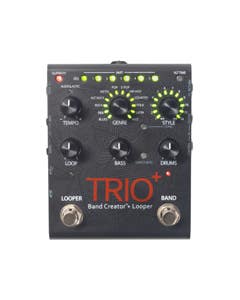
Digitech Trio Plus Band Creator with Guitar Looping Pedal
Special Price $349.99